


How Much to Tip in the Dominican Republic
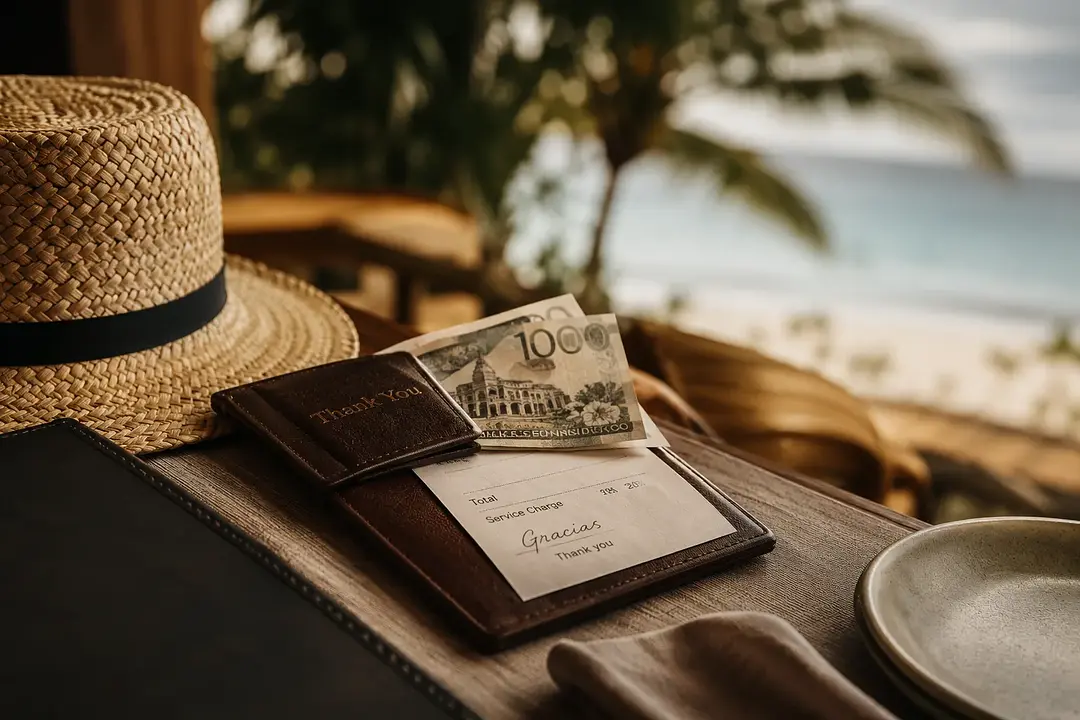
A short guide to tipping in the Dominican Republic: where a tip may already be on your bill, where it’s appreciated, and where you can comfortably skip it.
Cheat sheet: how much to tip
| Who | How much |
|---|---|
| Restaurant | 10% is often already on the bill (Propina / Ley line) - check your receipt; an extra 5-10% is optional |
| Hotel housekeeping | $2-3 per day |
| Bellboy | $1-2 per bag |
| Bartender (all-inclusive) | $1 or 50 pesos every couple of drinks, or $2-5 once a day |
| Tour crew (guide + driver) | $10-20 per family or group for a full day |
| Taxi | not expected; rounding up is enough |
All amounts are a guideline, not an obligation. Less, or nothing at all, is fine too.
Do you tip in the Dominican Republic at all?
Yes, tipping culture exists here, but it’s softer than in the US. The key thing to know: in restaurants and bars, a 10% service charge is usually already added to your bill by law - more on that below. Anything on top is a thank-you gesture, not a duty. Service industry wages are low, so even a couple of dollars is real help for the person who took care of you. More basics for your first trip: first-timer’s guide.
Pesos or dollars?
Both work. US dollars are accepted everywhere in tourist areas. A few practical points:
- A few small bills from home - $1, $5, $10 - solve the eternal change problem
- Pesos work just as well: 50 pesos is a perfectly fine small tip for a bartender or bellboy, 100-200 pesos for housekeeping
- If you pay a bill in dollars (restaurant, shop), ask about the exchange rate before paying - it may be converted at an unfavorable rate. For tips the rate doesn’t matter; for paying bills it matters a lot
- Coins of any foreign currency and torn or marked dollar bills are useless - banks won’t accept them
- Euros are okay for tips, but harder for staff to exchange than dollars
How much money to bring overall is covered in the vacation cost guide.
Check today’s dollar-to-peso rate in our currency converter before setting aside cash for tips.
What the lines on your bill mean: ITBIS, Ley, Propina
The first surprise in the Dominican Republic: menu prices and the final bill differ by almost 30%. It’s not a scam - that’s how local taxes work. A typical bill looks like this:
- Subtotal - the sum at menu prices
- ITBIS 18% - the Dominican VAT, the equivalent of European VAT or US sales tax. Goes to the government
- Propina Legal 10% (may appear as “Ley”, “10% Ley”, or “Propina”) - a mandatory service charge under Article 228 of the Labor Code. This is the tip: by law the entire amount is distributed among service staff - waiters and bartenders. The owner doesn’t keep it
- Total - the final amount, roughly +28% over menu prices
What follows from this:
- Before tipping, check the receipt: if there’s a Propina / Ley line, the waiter’s tip has already been paid. Adding 5-10% in cash is worth it only for genuinely good service, and preferably handed directly
- Propina Legal applies only to dine-in orders. Takeout shouldn’t have that 10% on the receipt
- Small local eateries and street stands often print bills without ITBIS or propina - there the price is final, and any tip is entirely up to you
All-inclusive resorts: who and how much
“All inclusive” doesn’t mean tips are included. Formally the resort collects a service charge, but staff at big resorts live partly on guests’ tips, and the difference in service for those who leave even a dollar is noticeable.
- Bartender: $1 or 50 pesos every couple of drinks, or $2-5 once a day
- Housekeeping: $2-3 per day, ideally daily rather than one sum at the end - shifts rotate
- Waiter at an a la carte dinner: $2-5 per table
- Bellboy: $1-2 per bag
- Entertainment staff, concierge: optional, if they genuinely helped
A couple of dollars for housekeeping on day one works better than the same amount on the last day.
Restaurants outside the resort
Same rule: check the bill first. If the Propina / Ley line is there, the 10% is already paid. From there:
- Average service - it’s fine to add nothing
- Good service - round up or add 5-10% in cash
- Paying by card - better to leave the tip in cash on the table: a card surcharge doesn’t always reach your specific waiter
Tours and excursions
Tips are not included in tour prices. A tour usually involves a team - a guide and a driver, and on boat trips also a captain and crew. No need to count out each person separately: it’s easier to thank the whole team with one amount at the end of the day.
- Full-day tour: $10-20 per family or small group for the whole crew
- Boat trip: about the same, usually collected in a common pot at the end
- Short couple-of-hours tour: $5-10 total is plenty
Demanding or hinting at tips isn’t done here - it’s always voluntary. If the tour disappointed you, leave nothing.


Taxis, transfers, hotel staff
- Taxi: tips aren’t expected; rounding up is enough. Agree on the price before the ride
- Booked transfer: $2-5 for the driver if they helped with luggage
- Front desk: no tip needed, unless they did something special for you
More on getting around the country: transportation guide.
For cruise passengers
For a day in port at Taino Bay or Amber Cove, the rules are simple:
- Small dollar bills are the currency of the day. No need to exchange money into pesos for a few hours ashore
- Shore excursion crew - the same $10-20 per family for the whole team
- At a restaurant near the port - check the bill first: a Propina / Ley line means the 10% is already included
- Souvenir vendors don’t expect tips; haggling is the game there
More about a day in port: Taino Bay guide and Amber Cove guide.
What not to do
- Don’t tip with coins - foreign coins can’t be exchanged here
- Don’t hand out torn, taped, or marked dollar bills - banks won’t take them
- Don’t confuse ITBIS with the tip: the 18% is a government tax, not the waiter’s money
- Adding 15-20% on top of the included 10% isn’t necessary: it will be gladly accepted, but 5-10% extra is plenty for excellent service
- Don’t tip ostentatiously or expect special treatment in return - it’s a gesture of gratitude, not a transaction
More about cash, exchange and ATMs - in our money in the Dominican Republic guide.