


Getting Around the Dominican Republic
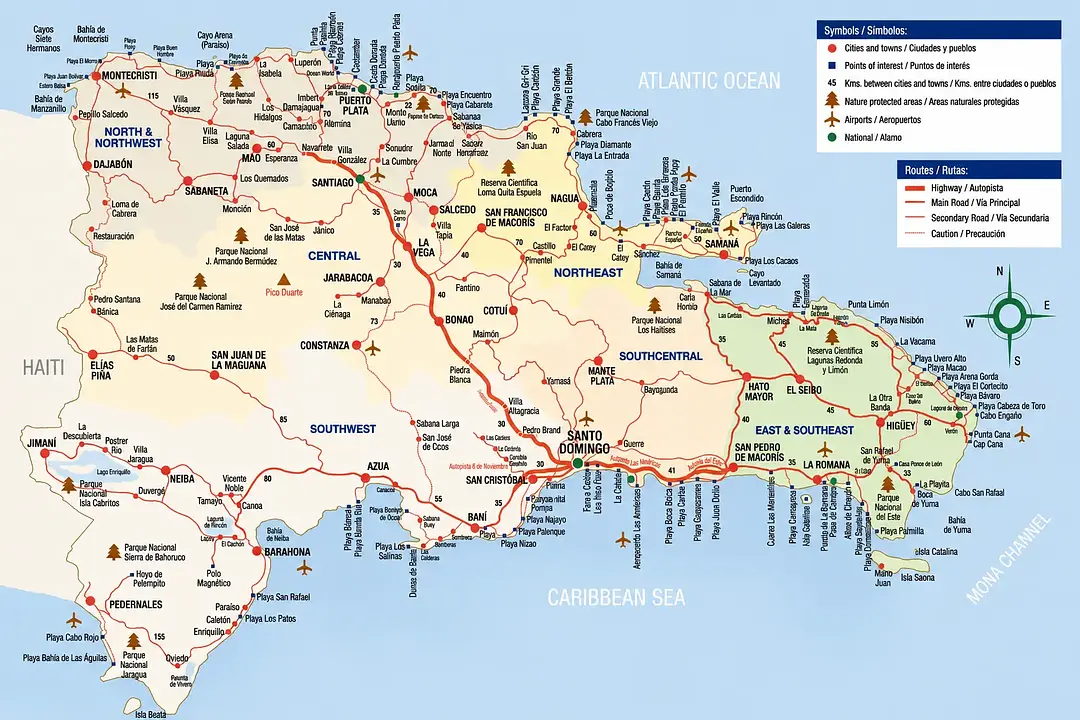
You landed. You cleared customs. You’re standing outside the airport with a suitcase and zero idea how to get anywhere.
Don’t worry. The Dominican Republic has more transportation options than you’d expect - from air-conditioned highway coaches to motorcycle taxis that weave through traffic like they’re late for their own wedding. Some are comfortable. Some are an adventure. All of them work.
Here’s how locals and smart tourists actually get around.
Long-Distance Buses: Caribe Tours & Metro Tours
If you need to travel between cities - say, Santo Domingo to Puerto Plata, or Santiago to Sosua - two companies dominate the highways: Caribe Tours and Metro Tours.
These aren’t the rattling buses you might be imagining. We’re talking full-size coaches with air conditioning, reclining seats, onboard restrooms, and Wi-Fi. Think Greyhound, but cheaper and arguably more comfortable.
Caribe Tours has the largest route network in the country. They go everywhere - Puerto Plata, Santiago, Samana, Barahona, Jarabacoa, and dozens of smaller towns. They run hourly departures on popular routes and have organized terminals in every major city. Tickets cost roughly RD$400-550 one way depending on the route (that’s about $7-10 USD).
Metro Tours covers similar main routes - Santo Domingo to Santiago to Puerto Plata and Sosua. They’re known for orderly boarding, comfortable seats, and a slightly quieter ride. A few pesos more on some routes, but many travelers swear by them.
A few things to know:
The A/C on Dominican buses is no joke. It will be cold. Bring a sweater, a hoodie, a pashmina - whatever you have. You will thank yourself two hours into the ride.
Buy your ticket at the terminal. Caribe Tours lets you reserve online, but you should confirm two hours before departure. Arrive at least 30 minutes early for popular routes.
The trip from Santo Domingo to Puerto Plata takes about 4 hours (3.5 on the express). Santo Domingo to Santiago is roughly 2.5 hours.
There’s also Expreso Bavaro for the east coast - the only major bus connecting Santo Domingo with Punta Cana/Bavaro area.
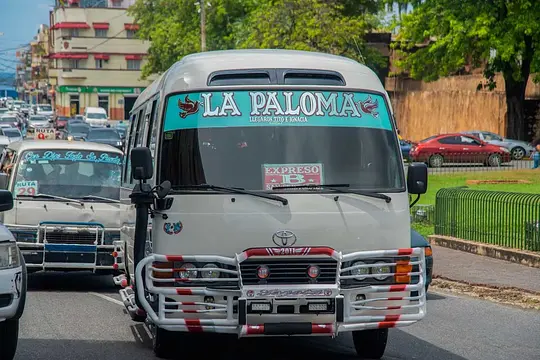
Guaguas: The Local Minibus
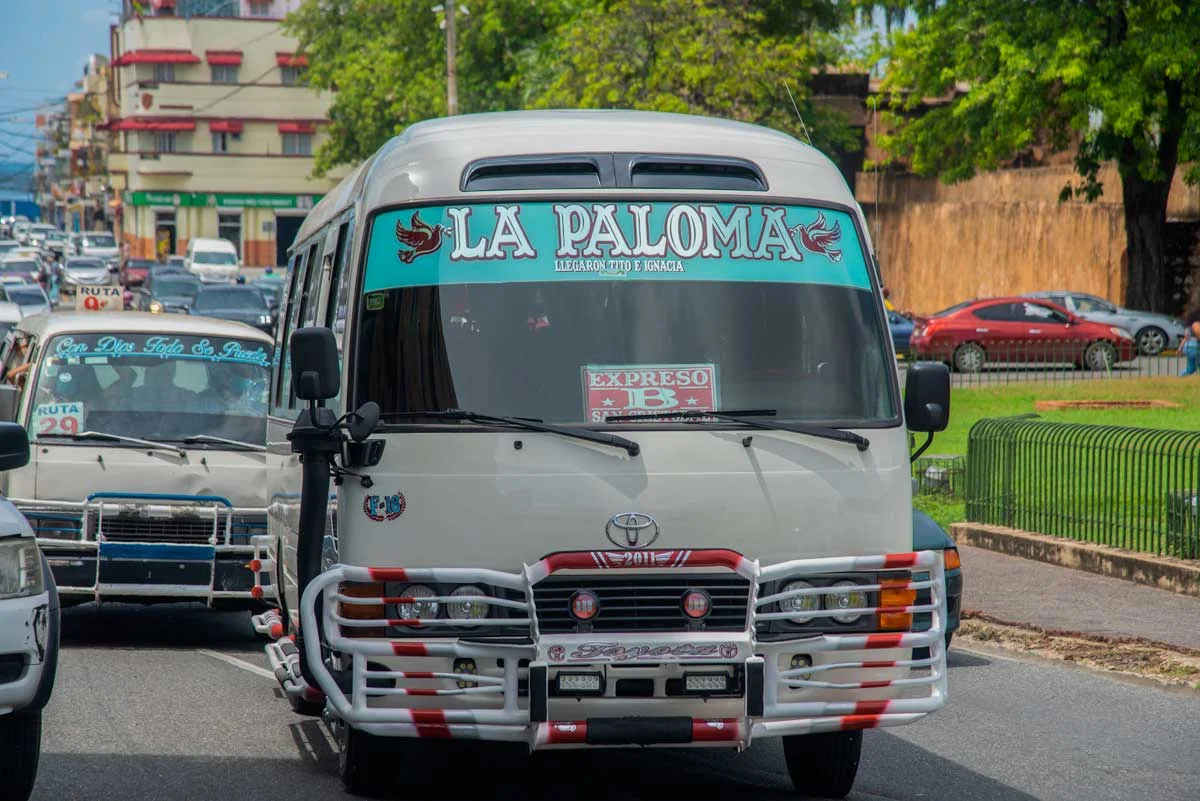
The word “guagua” (pronounced WAH-wah) means bus in Dominican Spanish. But forget everything you know about buses.
Guaguas are privately owned minivans or small buses that run fixed routes between towns. They connect Puerto Plata with Sosua and Cabarete, shuttle people between Santo Domingo neighborhoods, link small towns across the Cibao valley - they’re everywhere. They’re the backbone of local transportation - cheap, frequent, and impossible to miss.
Here’s how it works: you stand on the main road, a guagua comes by with its destination written on the windshield (or shouted by the cobrador - the fare collector hanging out the door), you wave it down, hop in, and pay. Fares between nearby towns run RD$50-150 (about $1-3 USD).
Guaguas don’t follow a schedule. They leave when they’re full. And “full” is a relative concept - you might share the ride with 25 people in a 15-passenger van, a few bags of rice, and possibly some chickens. The windows are open, the music is loud, and it’s the most Dominican experience you can have for a dollar.
They’re slower than other options because they stop constantly to pick up and drop off passengers. But if you’re not in a rush and want to see real daily life outside the resort, take a guagua at least once.
Important: guaguas don’t run at night. Plan accordingly.
Carros Publicos: Shared Taxis
Carros publicos (also called carritos or conchos) are regular sedans - usually Toyota Corollas that have seen better days - operating as shared taxis along fixed routes.
The system is simple but can look chaotic from the outside. The car drives its route, picks up passengers going the same direction, and drops them off along the way. No apps, no meters. You flag one down, tell the driver where you’re going, and pay a flat fare.
Here’s the part that surprises first-timers: they fit four passengers in the back seat and two on the front passenger seat - plus the driver. That’s seven people in a regular sedan. It sounds insane. It works.
If you want more space, you can “buy” the front seat for yourself by paying double the regular fare. Or you can hire the entire car as a private taxi by paying for all the empty seats - just tell the driver “completo” or “todo el carro.”
Fares are very low - typically RD$50-100 for a ride within a city or between nearby towns. They’re faster than guaguas because they don’t stop as frequently. Unlike guaguas, carritos also run at night.
Pro tip: have small bills ready. Drivers rarely carry change.
Motoconchos: Motorcycle Taxis
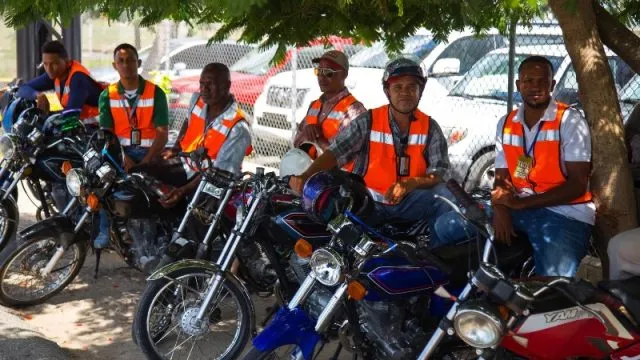
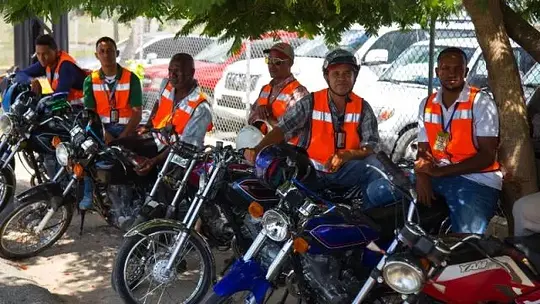
Motoconchos are the fastest and cheapest way to get around any Dominican town. A guy on a motorcycle pulls up, you hop on the back, and he zips you to your destination through traffic, around potholes, and occasionally across sidewalks.
In smaller towns across the country, motoconchos are often the primary form of in-town transportation. You’ll see their drivers congregating at busy intersections, near supermarkets, or in front of shopping areas, usually wearing bright colored vests.
Fares start around RD$50-100 for short rides within town. Always agree on the price before getting on. And yes, prices double after dark.
A few safety notes:
Look for drivers wearing official-looking vests - they’re more likely to be licensed. Ask your hotel which motoconcho stand they recommend. Helmets are legally required but rarely provided - if safety is a concern, consider other options. Motoconchos are best for short distances in smaller towns, not highway travel. Once you get comfortable with it, you’ll understand why locals prefer them. They’re fast, they’re everywhere, and they cost almost nothing.
Locals who find a reliable motoconcho driver save their phone number and call them directly when they need a ride - like having your own personal driver for a fraction of the cost.
Uber and Ride-Hailing Apps
Uber works in the Dominican Republic - specifically in Santo Domingo, Santiago, Puerto Plata, and Punta Cana. If you’re used to ride-hailing apps at home, this will feel familiar.
Prices are generally lower than traditional taxis, you get upfront pricing, GPS tracking, and you don’t need to negotiate. It’s a solid option in the cities where it’s available.
That said, availability can be spotty outside city centers. At the Puerto Plata airport, for example, you might not find a driver immediately. In Punta Cana, traditional taxis still dominate because of strong local taxi associations.
Other apps you might see: inDrive (popular in the DR - you negotiate the fare with the driver through the app) and DiDi (available in Santo Domingo and Santiago).
For airport pickups, asking your hotel to arrange a transfer is often the most reliable option.
Renting a Car
If you want complete freedom to explore - whether it’s the coast between Puerto Plata and Cabarete, the mountains around Jarabacoa, or the beaches of Samana - renting a car makes sense.
The Dominican Republic has modern highways connecting all major cities. The roads between tourist areas are generally in good condition. That said, driving here requires some adjustment: lanes are more of a suggestion, motoconchos appear from nowhere, speed bumps come without warning, and the general driving style is… enthusiastic.
A few practical tips: get a vehicle with insurance included, opt for a compact SUV if you plan to go off the main roads, and always lock your car. International and local rental agencies operate at all airports and in major tourist towns.
At Sunny DR, we offer car rentals across the Dominican Republic - and because we’re local, we can give you honest advice about routes, road conditions, and where to park.
Excursion Transfers
If you’re booking a tour or excursion, transportation is usually included in the price. Most reputable tour operators pick you up at your hotel or a nearby meeting point, take you to the excursion site, and bring you back.
This is one of the easiest ways to get around if you’re staying at a resort and want to see more of the island without figuring out buses and routes. Waterfall tours, snorkeling trips, city tours, catamaran excursions - they almost always come with round-trip transport.
That said, “almost always” isn’t “always.” When booking any tour, confirm whether the transfer is included, where exactly the pickup point is, and what time you’ll be returned. Better to ask one extra question than to be surprised at 6 AM with no ride.
All Sunny DR excursions include hotel pickup and drop-off - but we’ll always confirm the details with you when you book.

Quick Reference: What to Use When
Airport to hotel (same city): Uber, hotel transfer, or taxi. Ask your hotel to arrange it.
City to city (Santo Domingo - Santiago - Puerto Plata): Caribe Tours or Metro Tours. Cheap, comfortable, reliable.
Town to town (Puerto Plata - Sosua - Cabarete): Guagua or carro publico. Fast and cheap.
Getting around town: Motoconcho for short hops, Uber where available, or walk.
Exploring freely at your own pace: Rent a car.
Going on an excursion: Book a tour with transfer included. Confirm the details.
The Bottom Line
You don’t need a car to enjoy the Dominican Republic. Between intercity buses, guaguas, carritos, motoconchos, and Uber, you can get almost anywhere for very little money.
The “best” transportation depends on your comfort level, your budget, and how much adventure you want. Taking a Caribe Tours express bus is smooth and easy. Riding a guagua packed with locals on a Saturday morning is an experience you’ll tell stories about for years.
Either way, you’ll get where you’re going.
And if the whole thing sounds like too much planning - just book an excursion. We’ll handle the driving.
Questions about routes or transfers? Message us on WhatsApp - we’ll point you in the right direction.